Nepal’s Greatest Threat Is Youth Unemployment, Not Politics
A youth unemployment rate exceeding 20 percent must alarm the new governmet and every institution in the country. This is not just an economic concern but a threat to our democracy as well.
Shree Gurung
5/14/20263 min read
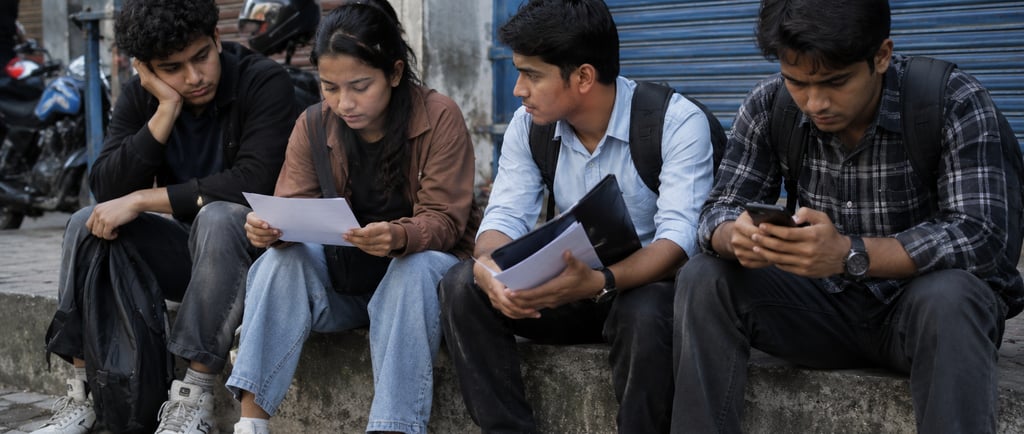
Nepal’s greatest immediate threat is not political opposition, ideological rivalry or coalition instability but the youth unemployment. A youth unemployment rate exceeding 20 percent must alarm the new governmet and every institution in the country. This is not just an economic concern but a threat to our democracy as well.
Studies and reports around the world shows that countries with high youth unemployment are prone to political unrest, polarization, institutional distrust and instability. Unemployed youth eventually lose faith not only in governments, but in the system itself. No government will remain politically secure if it fails to create employment and opportunities for the youths, this government must acknowldege and take it seriously.
The government today appears heavily focused on past irregularities, corruption and injustices. Accountability is important and reform is necessary, but a nation already suffering from high unemployment, low investment confidence, weak industrial growth and economic uncertainty cannot move forward through fear and confrontation alone.
Taking a jab at private sectors, oppositions, bureaucracies, informal settlements, financial institutions and even justice system may create temporary political headlines, but it will further tangle the country’s economic momentum and delay prosperity. The government must remember, it’s easy to destroy a corrupt system but building a fair and functional one is far more difficult. In the pursuit of good governance, there is always a risk of impunity specially in the current scenario.
The Policy and Programme has tried identifying the issue however the budget must now prove whether the government is serious about employment, investment and economic transformation. The government must focus on its core objective: creating jobs, building trust and accelerating economic growth then it can afford a better infrsastrcutre and facility to serve the people. Our history has already shown how political instability has repeatedly destroyed the economic confidence. No country can prosper without long-term investment, and no serious foreign investor will commit billions of dollars into a country where policies shift unpredictably, institutions appear unstable and political rhetoric creates fear rather than confidence.
Foreign Direct Investment does not only seek profit; it seeks trust, stability and safety. If we truly want to achieve the ambition of becoming a $100 billion economy within the next five years, we must aggressively target at least $10 billion in annual investment inflows through partnerships with domestic private sectors, global investors and the Nepali diaspora.
This number is not unrealistic provided our natural resources and human capital as our core strength of “Jal, Jamin ra Janashakti”. These are not just slogans but strategic economic assets that is rarely possesed by the countries across the world.
According to Nepal Rastra Bank and Department of Customs data, Nepal’s agricultural and food import is approximately $3 billion annually, which itself represents one of the largest investment opportunities in the country. We import rice, vegetables, seeds, fruits, grains, dairy products and processed foods despite possessing fertile land, favorable climate diversity and abundant water resources.
The solution is not political speeches asking youth to return to villages, The solution is making agriculture profitable, modern and technologically driven. The government must facilitate with modern agro tools, AI infused systems, drone technologies, smart irrigation systems, cold storage and dehydration infrastructure, food processing industries and access to low-interest financing for young entrepreneurs and hassle free insurance for their investment safety. Technology-driven agriculture can create large-scale employment while simultaneously reducing imports.
The same applies to tourism. Nepal holds one of the greatest tourism potentials in South Asia, yet we have failed to capitalize it with better infrastructure, aviation partnership, destination branding and investment-friendly policies. Nepal can realistically target over $5 billion annually from tourism revenue alone. From Lumbini to Pashupatinath, Janaki to Muktinath; Nepal can attract millions of visitors from the region with a strategic partnership. Countries such as Thailand, Japan and Sri Lanka have already demonstrated how spiritual tourism can become a major economic driver.
Being the capital of the Himalayas, we hold global appeal in adventure tourism and mountain sports while wellness retreats, eco-tourism, entertainment tourism and creator-driven travel experiences can attract millions of south asian youths due to the proximity in land and culture. We must understand, tourism holds the potential to generate employment at scale.
We grew up learning, our greatest asset is our Himalayas, glaciers, rivers and the hydroelectricity capacity that can become Nepal’s single greatest economic multiplier. We must build a strategy and policy that can attract global tech giants to invest in our hydropower along with the traditional energy trade. Balancing FDI investment in AI-AGI and regional trade could potentially attract over $15 billion in energy-related investments within the next five years.
Technology itself presents another major opportunity.
Almost half a billion revenue from technology export is serious indication of it’s scalibility, despite the failure of previous governments to acknowledge, address, facilitate and support the tech industry. We have a potential to build a multi billion dollar tech industry.
This government must understand none of this can happen through centralized control and political insecurity. State alone cannot deliver economic transformation, partnership between government, private sectors, investors, entrepreneurs, local communities and citizens is the only realistic path forward. Traditional roleplay of late kings and dictators might sound great in social media but the new era belongs to the people and partnership.
About me Business&Organiations Gallery Contact me
Octave Corporates
Durbarmarg, Kathmandu Nepal
shree@shreegurung.com